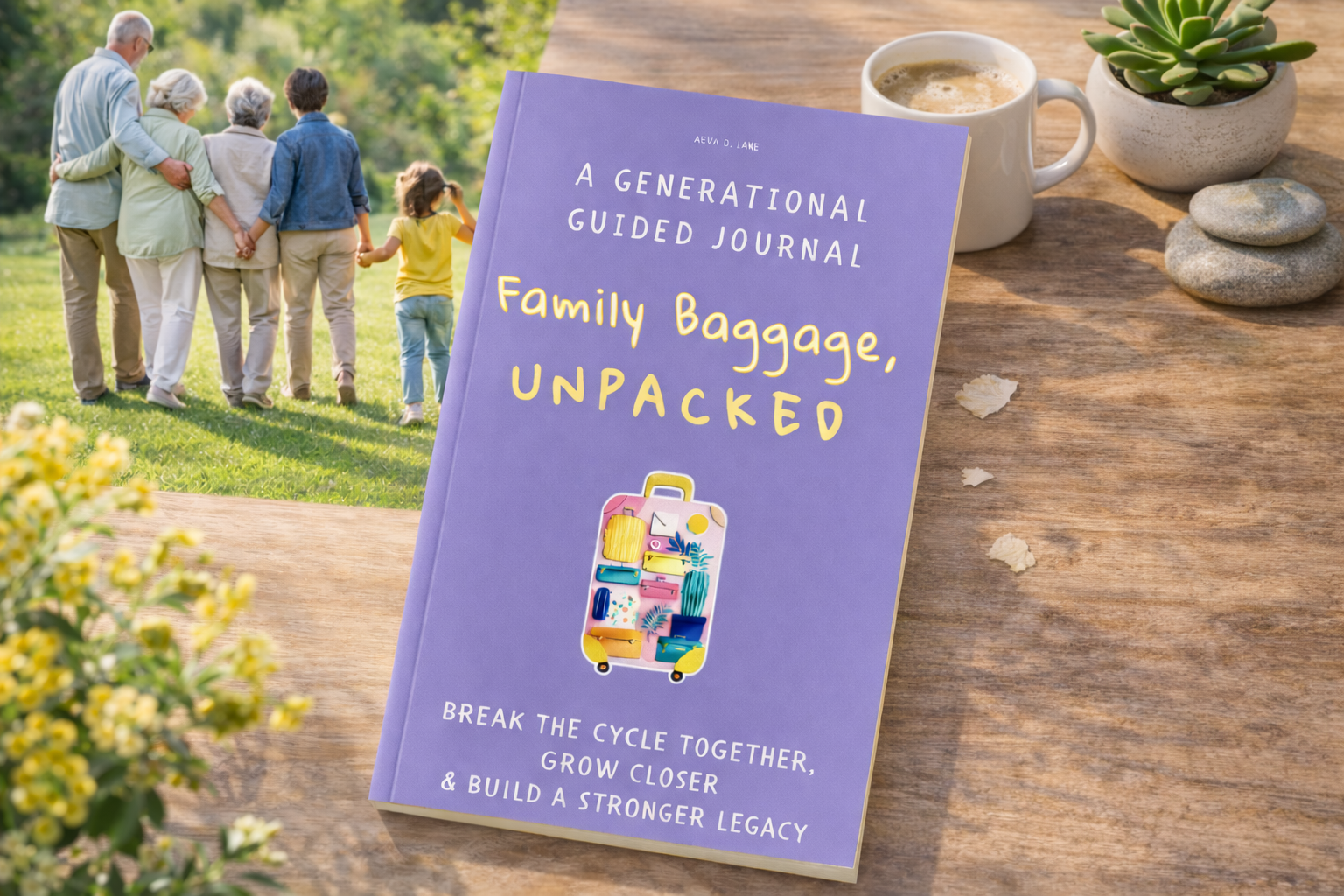
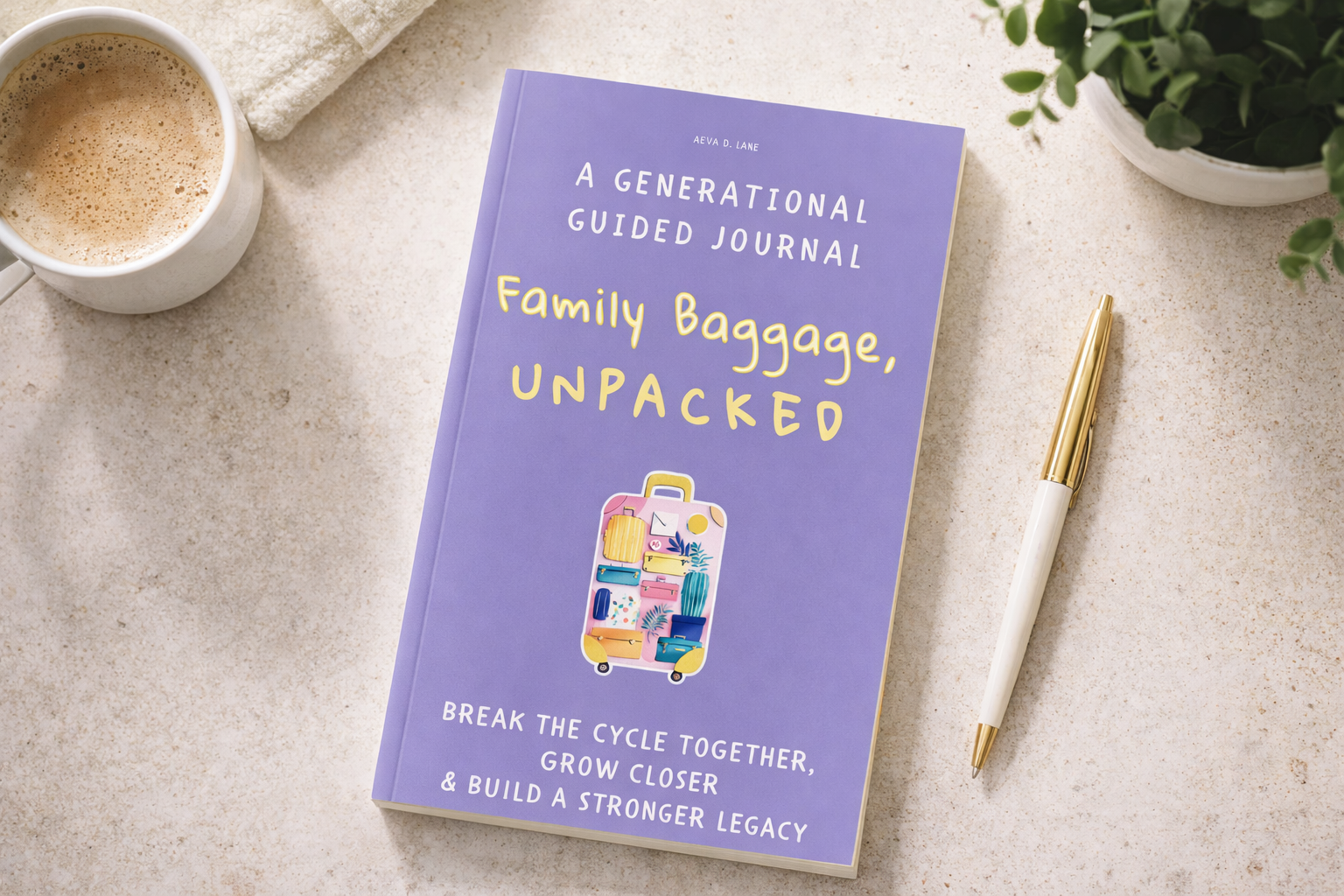
A multigenerational guided journal for families ready to explore inherited patterns, unspoken rules, and emotional legacies — and consciously choose what comes next.
Therapy's friendly cousin: less clinical, more curious, still deeply effective.
See What's InsideNo blame required. No perfect family needed. Just the willingness to look at what you've been carrying.
This isn't a family scrapbook. It's not a "cherish every moment" memory book.
It's for the stuff underneath.
It's for the families who talk nonstop and the ones who barely do. For those who laugh easily and those still learning how. If your story includes love, chaos, hope, or resilience — you're in the right place.
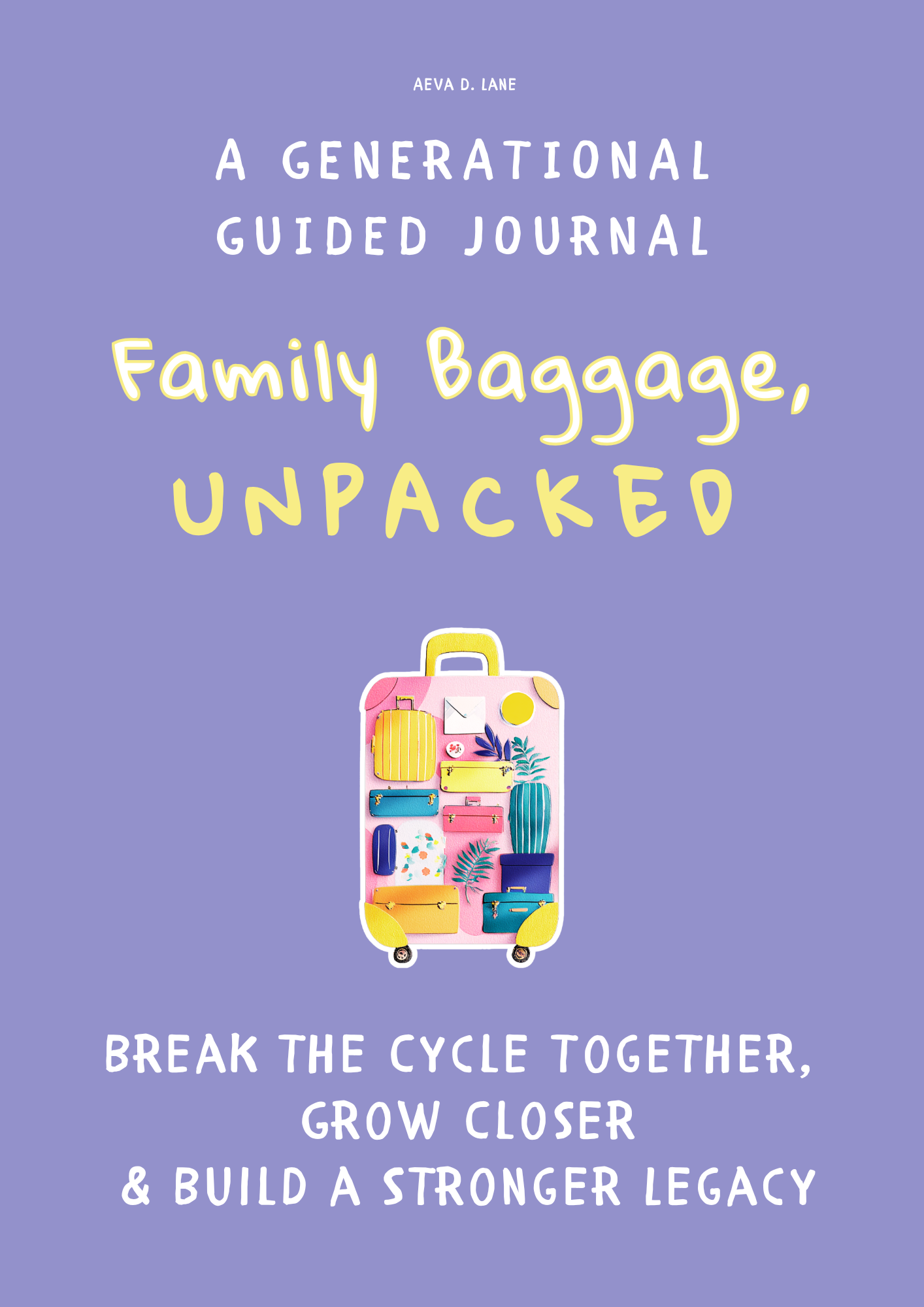
Family Baggage, Unpacked is a guided journey through six layers of your family story — from the emotional weather you grew up in to the legacy you're choosing to build next.
Trace your family's repeated scripts — the ones that whisper "this is how we do things." This section turns "what's wrong with me?" into "where did I learn this?" — a shift from blame to understanding.
Explore the invisible weather you grew up in — the tone, tension, or tenderness that filled your home. Was love warm and steady, or buttoned-up and quiet? Were emotions invited in, or told to wait outside?
Meet your family's survival superpowers. Maybe you learned to read a room like a psychic, stay strong through chaos, or find humour in the storm. Honour those skills — then gently upgrade from survival mode to thriving mode.
Every family has its cast: the Peacemaker, the Rebel, the Overachiever, the Caretaker. These roles once kept things balanced. This chapter invites you to meet your role, thank it for its service, and decide who you'd like to be next.
Learning where you end and others begin. Not about cutting people off — about creating space for honesty, respect, and peace. You choose what to keep, what to release, and what kind of emotional climate you want to build.
The sorting: name what you're keeping, what you're setting down, and what you're transforming. Write your legacy statement — not as a wish, but as a decision. This is where awareness becomes action.
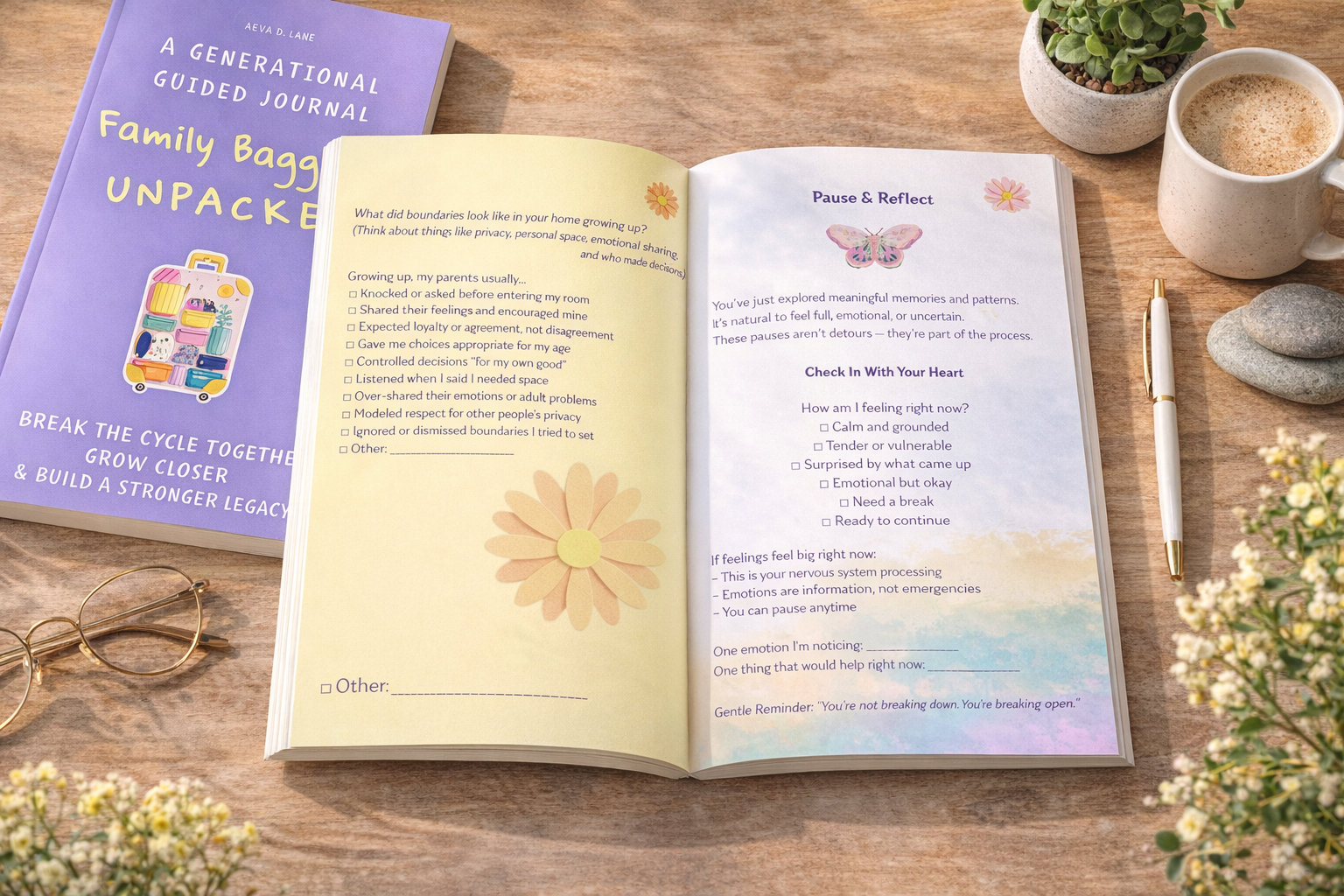
Every chapter includes prompts for you, your parents, and your grandparents — so each generation can share their perspective on the same questions. The answers are never the same. That's the whole point.
On your own, as a personal reflection tool. You don't need anyone's permission or participation to begin. Pick a chapter that makes you curious — or mildly nervous. That's usually the right spot.
Give pages to parents or grandparents. Interview them, send photos of the prompts, or have them dictate while you write. Each person adds their own layer of truth to the bigger picture.
When the stories overlap, the patterns emerge. That's where "this is how we've always done it" becomes "this is how we do it now." Not by force. By awareness.
Most family memory books ask what happened. This one gently asks how it felt — and what it taught you.
Shaped by attachment theory, family systems, and resilience psychology — translated into friendly prompts. You don't need a therapist. Just curiosity, honesty, and maybe a pen that doesn't run out halfway through a feeling.
Designed for you, your parents, and your grandparents — or anyone who's been a meaningful part of your story. Each person gets space to share their voice, creating a living legacy that grows with every contribution.
Whether your family is biological, blended, chosen, or adopted. Whether you talk five times a day or are carefully rebuilding after years of silence. The labels are flexible — the love is what counts.
"I asked my dad one question from this journal and he talked for forty-five minutes. I learned more about him in one evening than in thirty years."— Amazon Reviewer
"I always knew our family had 'stuff.' This journal helped me see the patterns without blaming anyone — including myself. I cried, I laughed, I finally understood."— Amazon Reviewer
"Bought this for my therapy homework. Ended up getting my mom and grandmother to fill in their sections too. It's become the most meaningful thing our family owns."— Amazon Reviewer
Grab "The 30-Day Integration Practice" — a free PDF companion that moves what you discovered in Family Baggage, Unpacked off the page and into real life:
No email required. It's yours to keep and share.
If you've ever thought, "Why do I keep doing this?" or "Where did I learn that?" or "I don't want my kids to carry what I carried" — this journal is your answer.
Available as a paperback via Amazon, or as a printable PDF you can download and print at home from Payhip.
Makes a meaningful gift for the holidays, family reunions, milestone birthdays, or anyone in therapy who keeps saying "it goes back to my family."
That's completely fine. You can fill in every section yourself — your memories, your perspective, your story. The journal works solo just as powerfully. You don't need anyone's permission to understand your own patterns. If family joins later, beautiful. If they don't, you're still breaking cycles.
Not even a little. Understanding isn't the same as attacking. You can love your family and still recognise that some of what they passed down doesn't work for you. They did the best they could with what they had. Now you get to do better — not because they failed, but because you have tools they didn't.
You can answer their sections from memory — what you think they'd say, what you wish you could ask, what you remember of their story. It becomes part tribute, part healing, part the conversation you never got to have.
Absolutely. The labels "parent" and "grandparent" are invitations, not restrictions. Step-parents, adoptive parents, guardians, mentors, chosen family — anyone who shaped your story belongs in these pages. Family has never been a one-size-fits-all story.
Yes — many people do. The prompts are informed by attachment theory and family systems psychology, so they pair naturally with therapeutic work. Bring it to sessions, use it between appointments, or let it guide conversations your therapist would approve of.
Every family passes down more than recipes and baby photos. We inherit beliefs, emotional habits, and quiet rules about what's okay to feel. Most of it was never chosen — just absorbed.
Patterns continue until someone chooses to look at them.
You are that person.
The bridge between what was
and what comes next.